Every airplane, from the largest military cargo transport to the smallest two seat taildragger, has a weight limitation. It is the product of the engineering department of the company that made the airplane. Factors include the horsepower/thrust of the engine(s), the nature and strength of the landing gear, the width and length of the fuselage, fuel consumption rates and fuel capacity, and a host of other factors known only to those in the cloister where they keep the gnomes who do the calculation. Weight is why airlines want plastic forks and plates and not stainless and china. Weight is why the limit on carry-on bags, and why you pay extra if your baggage is over a certain limit. Weight limitations are why a private pilot will discreetly ask his passengers what they weigh and ask that they pack their baggage to be light as possible.
The most flexible tool to keep an airplane under its maximum gross weight is the subtraction of fuel from the maximum amount it can hold (unless it is leaving your No Count Father-In-Law or your Dear Mother-In-Law at home, but more on that later). The pilot, once he has the pax weights and he estimates or weighs the baggage, blows the dust off the top secret book that only pilots are allowed to have, reviews the magic formulas, and begins to figure out if he is going to be able to carry enough fuel to make it to his destination without a fuel stop, or if he does have to stop, where will he stop.
Fuel burn is calculated as gallons or pounds per hour, so the length of time for the flight must be calculated as well. Fuel stops are expensive, and it is preferred to limit them, but forced off-airport landings due to fuel exhaustion are more so, along with the indignity of the razzing one will receive the next time he goes to the airport if he should survive the event.
Which brings me to the in-laws. The brother of my No Count Father-In-Law (I am the Good-For-Nothing Son-In-Law, by the way) was celebrating his 90th birthday in late April of 2018. Everyone wanted to be there for the big event, and the wife wanted to catch up on things with her long-lost cousin. So, in-laws, wife, daughter, her 18-month-old son, and me – every seat would be filled.
Uncle resides in Yuma, Az. My family resides in Farmington, NM in the Four Corners Area, so the trip there would be literally across the state: from the northeast corner of Arizona to the southwest of Arizona. It is probably the farthest trip we could make if we wanted to visit somewhere in Arizona.
Into the secret lair with the musty books to make calculations about the flight. As the crow flies, with a curve or two because of military airspace restrictions: 405 nautical miles or 466 statute miles.
Time heading west (against the wind) 3 ½ hours. The zero-wind fuel burn (no headwind flight time of 3 hours): 52 gallons. With the head wind: 62-66 gallons on a conservative estimate. Oh man, the magic formula yielded that I was only going to be able to carry 65 gallons of fuel total with this “payload” (including the golf clubs, the golf clubs were very important!) Fuel stop required! The Lance glides one level above a brick so I could not count on making the last stretch to Yuma as a glider.
Back into the secret lair for more wizardry. Okay, a fuel stop in Winslow, Az to bring the fuel back to the starting level would get us to Yuma with an hour’s fuel reserve – my preferred standard. We are golden; except . . . Well, you need some of the backstory first.
Dear M-I-L had been vacillating for over a week about whether she would go to this austere event. She had suffered a serious fall a few months before and was having to wear this necklace that she swore was the latest fashion, but it looked remarkably like a neck brace to the rest of us. Despite having the latest in fashion design, she had shown some reluctance to make public appearances of any significance, and she was concerned that any turbulence or the landing might jar her neck. (My landings???! My landings???! The woman surely was thinking of landings of past flights with someone else!)
Well, No Count F-I-L was not going to leave Dear M-I-L alone for fear, apparently, that someone would try to steal the high-fashion necklace, nor would he allow anyone else to stay with her so he could attend the big event. So, things continued to hang up in the air.
Another twist, less than two weeks before the big event, I received a notification of a training event scheduled for that Saturday which I could not change and which I needed to attend. So, to make everything happen, I was going to fly everyone down on Friday and return the same day. I would then fly down early on Sunday morning, pick up the herd, and head back to KFMN.
On the Wednesday before the big event, I go to the airport and do the pre-flight on the airplane. Luckily, I had not yet refilled it from my trip to Denver a week or so before, and the fuel was sitting right where I needed it. Looking good!
Thursday afternoon, 4 p.m., No Count F-I-L calls and informs me that he and Dear M-I-L will not be going. Wife and daughter still wish to go. Change of plans! I now have enough weight available to fill the airplane to its maximum (another 30 gallons) and get there with plenty of fuel to spare. I leave work right after 5 p.m. (rare for me), run to the airport, pull the airplane out of the hangar so it can be fueled, call the fixed base operator, and top off the tanks. Locked and loaded for a 7 a.m. departure. Put the airplane to bed, and head to the house. And then, THE CALL came.
Eight p.m. and THE CALL from No Count F-I-L: Dear M-I-L had changed her mind again and they would be going to Yuma; oh, and the golf clubs would be coming too. Oh No! I now have an airplane that will be 180 lbs over max gross weight! What to do?
Well, I can’t pull out the seats, I don’t think pulling the carpet out is a good idea, and the radios? Well, they are kind of expensive. Back to the basic source of ballast: fuel.
Now general aviation aircraft are well designed for getting fuel into them, but not for getting fuel out, except through the exhaust pipe. This is going to be interesting.
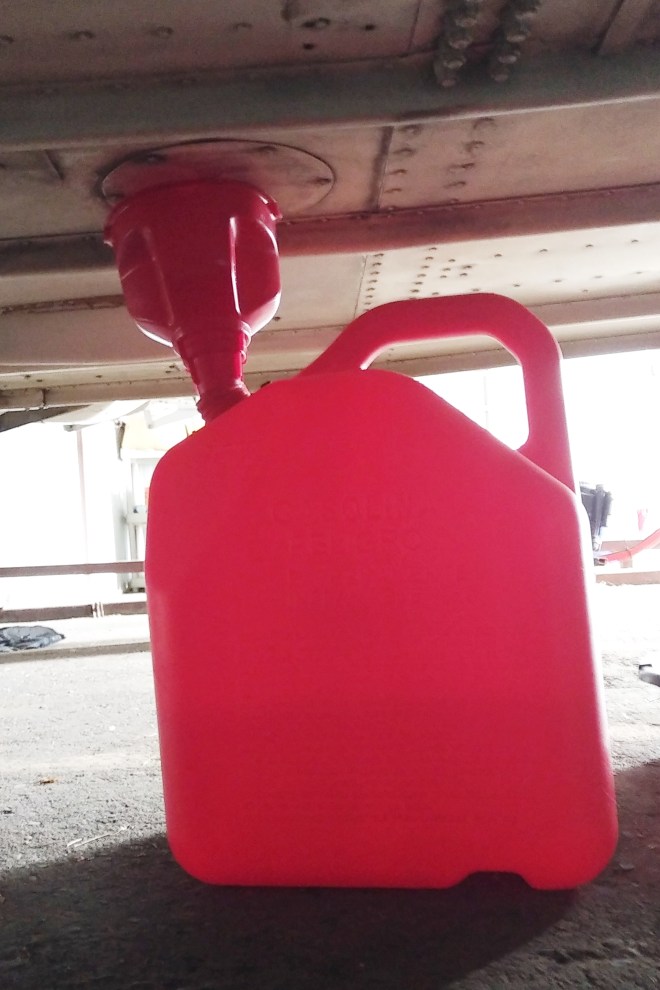
Visit with Wife. Walmart is still open. We run over somewhere between 8:30 to 9 p.m. and grab enough five-gallon fuel cans to hold the fuel we will need to draw down in order to make the limit. We grab a funnel to use if the fuel test drains will work for the project and a siphon hose in the event they will not. Av Gas is over $5.50 a gallon, and so it is treated as a precious resource.
Post 9 p.m. arrival at the airport. Solar-powered lights click on as we walk into the hangar. How to do this?
The Cherokee 6 line, including the Lance and Saratoga, have a fuel drain at the worst possible location: in the middle of the underneath belly. This is the lowest point in the system, and it needs to be tested for the presence of water and contaminants before each flight. It is a pain in the neck because one must crawl under the plane, place a container under the drain, go in the cockpit to press down a lever for a prescribed period of time, get out of the cockpit, retrieve the container, and check for bad stuff.
That’s it – we will use the belly drain! It will be a two-man job. I crawled under the plane with the numerous five-gallon containers and the funnel and held the funnel against the drain. Wife took on the difficult task of sitting in the cockpit and holding down the drain lever. It worked. “Extra” fuel safely in the gas cans. Everything buttoned up and ready to go for 7 a.m. the next morning.
We get home after 10 p.m. I do one last weather check and file the flight plan for a 7 a.m. departure. In bed by 11:30 p.m. with a 5:30 a.m. alarm set.
What happened next?
Flight cancelled. A front that was supposed to clear out did not do so. High winds across the region at 30 plus mph created warnings of moderate turbulence across the entire route of flight. Not the best scenario for Dear M-I-L and her sensitive neck.
Oh well: Time to Spare? Go by Air.
Sometimes that is the way it goes! Until next time, clear skies and tailwinds!
Gary Risley

 RizAir - A Private Aviation Journey
Oh man! I have cans and syphon tube. My question is what do you do with the fuel? Can it be put back in the A/C? I would wonder about contamination.
LikeLike
Yes, we put it back in the plane, but I ran it through a coffee filter to strain it.
LikeLike