Noun
orbis m (genitive orbis); third declension
- circle, ring
- a circular motion
- a rotation
- a disc or disc-shaped object
- the Earth, the world, the globe [often written as orbis terrarum]
totus orbis terrarum
the whole wide world
https://en.wiktionary.org/wiki/orbis
Well, you could not miss it, that was for sure. The Orbis MD-10, that is. It was the place where the press tours were being given at Wittman Field, Oshkosh, Wisconsin the day before AirVenture 2021 opened (#OSH21). The “MD-10” is unique in that FedEx converted its DC-10 fleet to a MD-11 cockpit format, eliminated the flight engineer, and, thus, the MD-10 was born. The airplane was donated by FedEx and the engines by United Airlines.

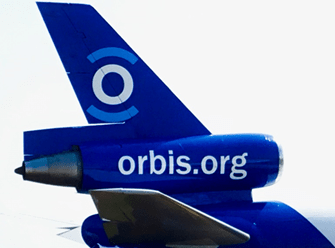
The plane was parked on Boeing Plaza, and as Annette and I entered one of the side gates, there standing above everything, was the giant engine located in the vertical empennage with the Orbis name. Pretty impressive right off the bat! It would only become more so as we went through the tour, viewed the hospital facilities, met staff and crew, and came to understand the mission.
Who They Are
Orbis is a charitable organization whose goal is to address the lack of medical services for those needing care for eye diseases. The Orbis MD-10 is a certified flying surgical center and hospital (more on this remarkable aircraft later). While treating eye disease is part of their mission, the primary focus is training doctors in the areas they serve to treat the patients in their respective locales. It is putting the “Teach a man to fish . . . “proverb into practice. Planning to go to a country with a need is often an 18 month planning process.
The organization started out with a DC-8 in 1982, then moved to a DC-10 (which is now in the Pima Air Museum in Tucson, AZ), to their current aircraft. While there is no official connection, FedEx and its employees are big contributors and constitute many of the aviation-related volunteers who serve Orbis. The current aircraft and its predecessor were donated by FedEx to Orbis upon retirement of the planes from the FedEx fleet. Other corporate sponsors provide in-kind materials and engineering and other support to keep the aircraft and the medical equipment up and running. Individual monetary donations are a very important component to funding operations because Orbis does not charge for the services and training it provides.
While the aviation-side is important to the operation, the heartbeat of the organization comes courtesy of the medical professionals: the doctors, nurses, assistants and techs. They provide the services and training that accomplish the mission: Eye Care Everywhere.
What They Do
As one might expect, pilots are always concerned about things that might affect their vision because without good vision they will lose their medical certificate and be unable to fly. Therefore, one might expect them to appreciate greatly any program that seeks to preserve or restore vision to people. Of course, pilots are not alone with this concern because most of us have lives and careers that would be impacted by a full or partial loss of vision. I suspect few readers have not personally suffered or had a family member who has suffered from vision issues.
Now, imagine that you live in one of the less-developed nations of the world. Vision problems that are routinely treated in modern, industrial countries are life-debilitating issues in such areas. Lack of facilities, lack of medications, and lack of trained professionals all contribute to this difficult situation.
Enter Orbis.
Orbis uses state of the art technology and tools to train doctors in countries all over the world to treat and prevent eye diseases. Over the years, Orbis has been able to set up learning centers in many parts of the globe and reach others through distant learning via the internet. Today, the massive McDonnell-Douglas aircraft provides about 25 percent of the training being performed by Orbis and operates approximately 100 hours per year flying time.
How They Do It
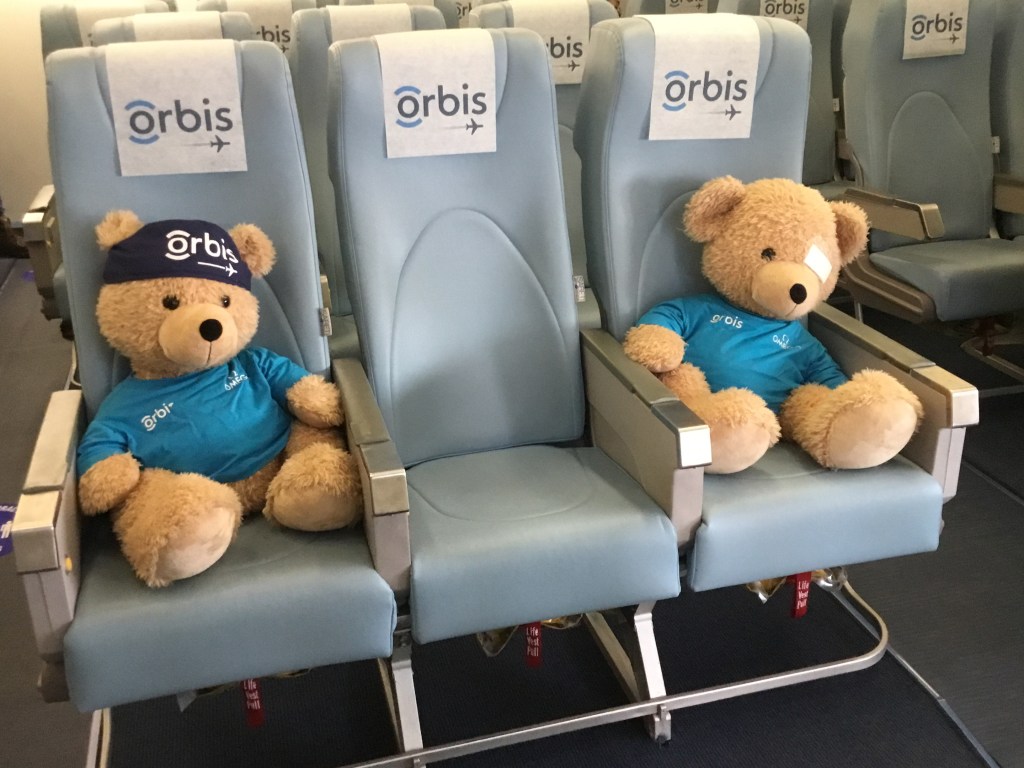
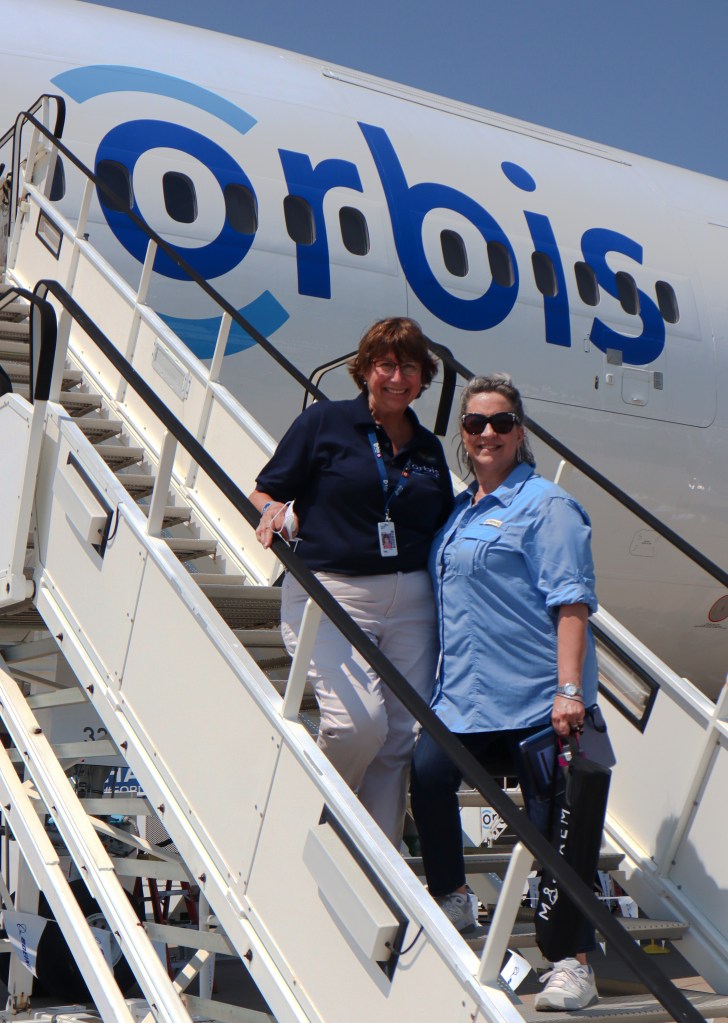
Captain Cyndhi Berwyn, a volunteer pilot for Orbis, and whose “day-job” is a trainer for the MD-10/11 for FedEx, kindly volunteered to be our tour guide. Captain Berwyn informed us that the MD-10 is a certified, flying hospital. Medical and aviation professionals from all over the world volunteer their time and skills to Orbis to help the less fortunate have access to medical care for vision problems. From the most highly-skilled doctor who is doing the instruction, the surgical assistant nurses, the flight crew, down to the airframe and powerplant mechanic who is in a tiny room in the belly monitoring all the systems while all the work upstairs is going on, each person makes up an essential cog in the well-oiled machine that is Orbis.The pilots are volunteers who are current or retired FedEx pilots. They do emphasize that when flying for Orbis that are not “FedEx pilots”, they are flying on their own certificates, and they are flying according to Orbis criteria, not that of FedEx.
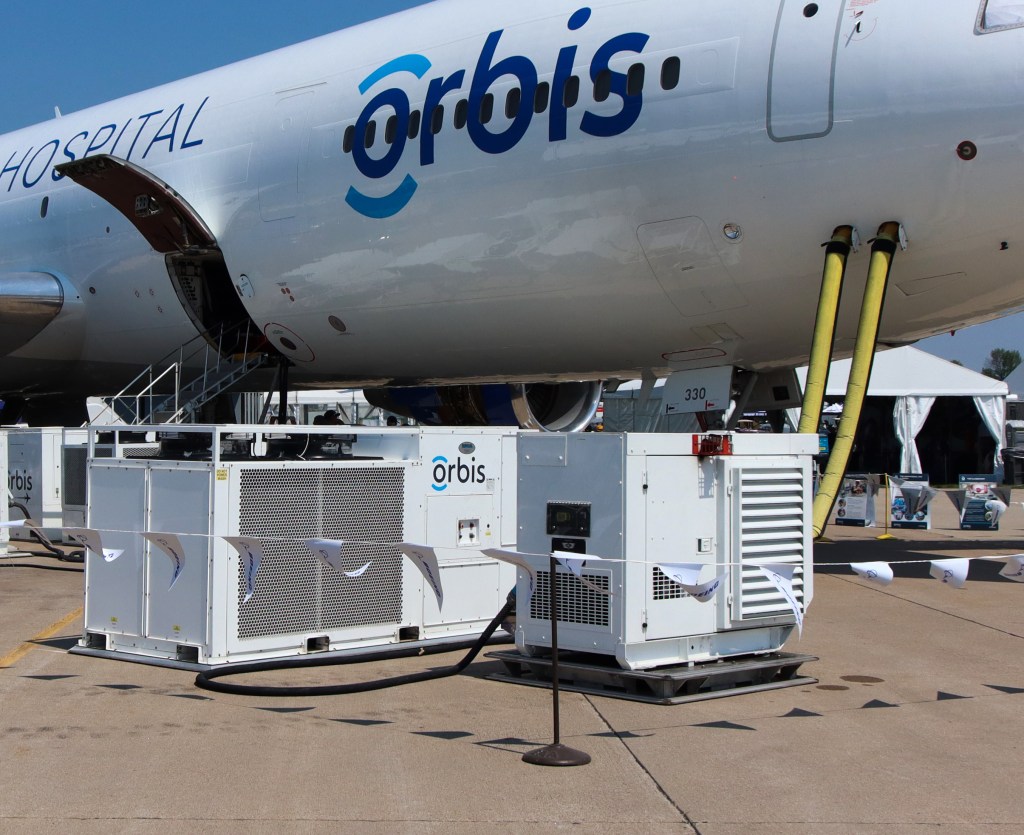
If you go to a remote country to teach and treat, you better bring everything you might need to do the job, including your own electricity.
The hum of the giant generators located next to the plane could be heard a hundred yards away. Captain Berwyn explained that the generators draw fuel from the fuel tanks of the airplane, and are always up and running while the aircraft/hospital was on station, which can be thirty days or so. When traveling, the generators are cranked up and stored in the giant belly of the beast.
The generators are needed because the reliable electricity we take for granted here in the United States does not exist in most of the world. The surgery center is heated or cooled to 68 – 72 degrees Fahrenheit, the recovery room needs to be comfortable, medications must remain protected or refrigerated, and the audio/visual system needs to be up and running for the doctor-students who are watching the procedure on high-definition televisions in the classroom and as they listen to the doctor-instructor concerning the procedure. The generators guarantee all of the foregoing will be accomplished.
Entering the aircraft at the front and turning to the right, one enters a large state-of-the-art 48 seat classroom. Students here are able to watch surgical procedures, listen to the instructor comment, and ask questions as procedures are taking place. If only my classrooms through all the years had been as well-appointed as this one!
Further back, on the starboard side of the airplane, to your left as you walk to the back, there is an administrative office, an audio/visual room, a patient intake center, an evaluation/laser room, and a surgical center. The sealed room that is the surgical center is state of the art for eye disease care and the operating room staff are some of the most elite professionals in the world. Doctors and staff come from all over the world, and often more than 20 different languages are being spoken by people on the airplane. “Students” are brought in and assist with the procedures as they learn. Staff often work in local hospitals as well as on the aircraft while on location.
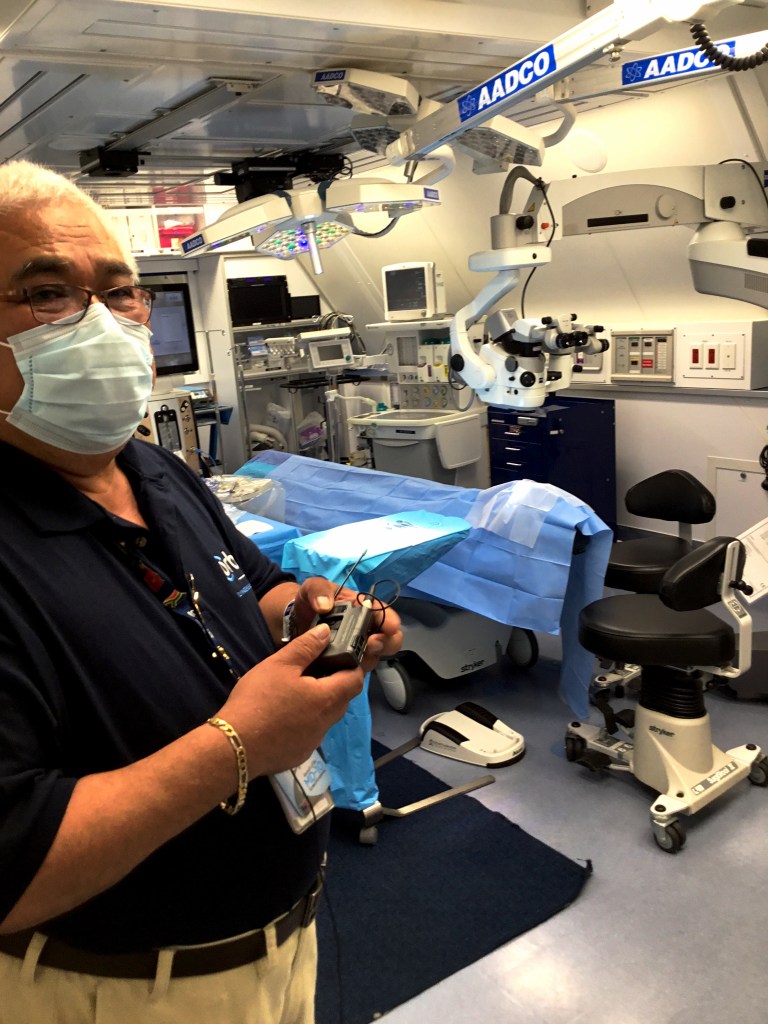
What is unique is that all of the interior “systems,” other than the classroom, – the surgical center, for example -, are “cans”. A suite in a box so to speak. So the surgical center and other interior items can be rolled on and off like cargo containers. This greatly simplifies mission availability because supplemental type certificates are not required since the operating theater and its supporting infrastructure never become part of the airplane. Just roll it on, lock it down just like a cargo box, do a new weight and balance, and away you go.
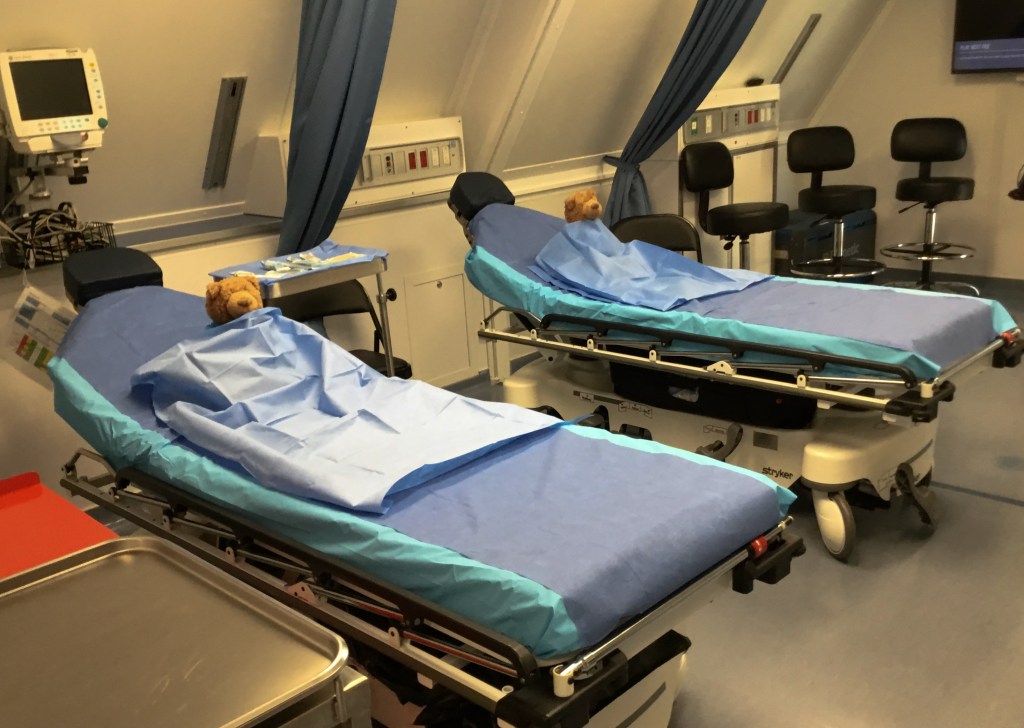
Unlike the one tank on the basic DC-10, the hospital has 6 water tanks. The “hospital” has its own water filtration system on a pallet that can handle just about any water wherever you may find it and purify it to medical grade standards. The HVAC system is on a pallet (again, no STC required) as are other mechanical systems supporting the hospital. Truly well-designed and engineered.
The Airplane:
Captain Berwyn acknowledged that the Orbis MD-10 is always a “heavy” airplane and it flies like one. No light and nimble fighter jet performance here. It is, however, an airplane that has been customized for its mission through the generous donations of many people and corporations.
Although it is a Part 91 operation, Orbis has its own set of operating specifications, maintenance procedures, and other criteria much like scheduled Part 121 carriers use. They do have paid maintenance staff (not a lot, but some), and they try to do all the maintenance on the aircraft themselves other than the “heavy” checks. (If you are not familiar, larger aircraft often go through a series of “phase” checks based upon either calendar time or flight hours, or both, and these are often referred to as “A”, “B”, and “C” checks.) Two to three A&P mechanics tag along on trips to monitor the airplane, repair what can be done in the field, and to monitor and maintain other equipment, including the critical generators.

The MD-10 has a max gross take-off weight of 565,000 lbs and a payload capacity of approximately 65 tons. That is a lot of tonnage, but a flying hospital requires a lot of equipment, space, and support systems, and the MD-10 very neatly fits the bill to fulfill this very important mission. Its three GE CF6-50C2 turbofans put out 54,000 lbs of thrust each.
In addition to the photographs in this article, I had intended to post video of the aircraft, but there are several YouTube videos that have been posted by more professional production organizations than I, so here are several links: https://www.youtube.com/watch?v=JmvJ0Zyd8AU&t=335s by Angle of Attack (www.angleofattack.com); https://www.youtube.com/watch?v=68XQ7juRXgs by Steveo1kinevo; how the DC-10 was converted to a MD-10 by Aviation International News: https://www.youtube.com/watch?v=UVhjAYhGggY; https://www.youtube.com/watch?v=4ROqLhT9a34 by Socialflight, and a Aviation Week report: https://www.youtube.com/watch?v=sAxkGTkvVkQ.
How It is Funded.
Orbis is an efficient charity. Ninety-two cents of every dollar donated goes directly to its surgery programs. It is 100% donor supported. The “Flight For Sight” donation plan allows you to donate $20 per month. At the end of one year, you will have donated enough to power the Flying Eyes surgery programs for an entire day. You may give at: www.orbis.org.
Until next time:
Clear skies and tailwinds.
Gary Risley
#charity #aviation #orbis #Airventure #OSH21 #flyinghospital #EAA #charityflights #volunteerflying #airmedical
Copyright November 2021 (No intent to claim copyright to linked videos or information.) All photographs by the author. Video produced by parties identified in the article.

 RizAir - A Private Aviation Journey