There is a rating for non-professional pilots that opens up a whole new world in private aviation. It is a rating that allows you to go into airports that might otherwise be closed due to temporary security restrictions, that allows you to depart an airport when you might otherwise be stuck on the ground, that allows you to land where you otherwise might not be able to get in, and allows you to deal with unforecast weather on that long cross country. It delivers the keys to the kingdom – it is the instrument flight rules rating.
For the non-pilot reading this blog, when a pilot obtains his or her private pilot certificate, the privileges of the license are visual flight rules (VFR) only. One may legally fly VFR so long as the clouds are 1000 feet above the ground and three miles visibility exists. In the modern world of tall radio and television towers, electricity generating windwills, and tall buildings, marginal VFR flight must be undertaken with care, if at all. Most pilots require much higher minimums for themselves before departing on VFR flights; typically, for example, clouds at 3000 AGL or better and 5 miles visibility or better. (A lot of the terms used in this blog are explained in much more detail in IF YOU’RE GOING TO HANG WITH THE NATIVES YA GOTTA LEARN THE LINGO! (A/K/A AVIATION ALPHABET SOUP rizair.blog/2018/06/20/if-youre-going-to-hang-with-the-natives-ya-gotta-learn-the-lingo-a-k-a-aviation-alphabet-soup/ )
Weather is always a factor in flying. While weather forecasting has improved tremendously over the past several decades, it still is an educated guess. While Sirius XM and ADS-B in-cockpit weather in all sizes and makes of aircraft has greatly enhanced the ability to obtain accurate, current weather along a route of flight, one only sees the weather that is developing while enroute to a destination. Nexrad radar via ADS-B or XM can be 10 to 20 minutes delayed. AWOS weather can be misleading because it often is reporting weather over the airport, and adverse conditions can exist just a few miles away. With this in mind, one must always keep in mind the words of the late Richard Collins: “The weather is what you see out your windshield.” Not what was forecast, not what you expected, what is actually present as we stare at the sky ahead and around us.
Without an instrument rating, unforecast and deteriorating weather can be a matter of serious concern, but it is a minor inconvenience, at the most, to an instrument rated pilot. Glancing through my logbook, I see several occasions where my instrument rating made unexpected weather a non-event. Flying into Abilene, Texas in a turbo-Baron at night, only to arrive and find a solid cloud deck with a ceiling of 800 feet AGL that was not forecast, is one instance. I asked Abilene Approach to convert me to IFR and was issued the 17L localizer backcourse approach. (It has been replaced by a GPS approach these days.) The cloud layer was about 700 feet thick. Down into the soup, line up on course, and pop out on final with plenty of room to spare.
Another occasion was a trip to Graham, Texas (KRPH) for a family reunion at Possum Kingdom Lake. I was in an A-36 Bonanza this time, but, guess what? An unforecast broken layer 750 AGL above the airport. No sweat. Pick up a quick IFR and fly the NDB approach (yes, an NDB, this was before GPS approaches were available and LORAN was still a big deal), and we are on the ground and on the way to the lake. The same thing has happened at Hereford, Texas (KHRX) (a half-way point fuel stop to KABI or the D/FW area) on more than one occasion; once again, both back in the day of NDB approaches and in the era of GPS approaches.
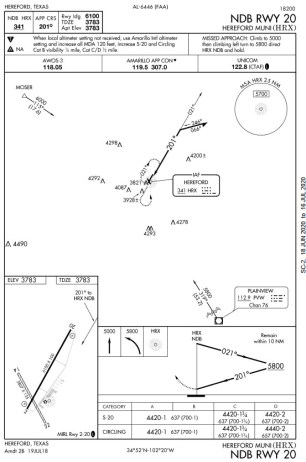
Still another occasion comes to mind. This time I was on an IFR flight plan from KABI to KFMN (Farmington) in a BE58 Baron. The flight was mostly in VFR conditions. The weather at Farmington was forecast to be VFR. At about 60 miles from the airport I was advised that the weather was at ILS minimums with light snow (again before real time cockpit weather – the plane did have a radar, but that did not help in this situation). Pull the plate, review the approach, and we were safely on the ground back home.
I could relate more stories regarding unforecast weather. My IFR ticket made items that would have been of concern or undoable non-events and has opened up the skies to me when I might otherwise be grounded.
Beyond weather, IFR can make it easier to get where you want to go. One example was related to the 2018 election cycle. My son was finishing up medical school in Phoenix and my wife and I had planned a weekend visit. (About a 2 hour to 2:15 hour flight.) A problem cropped up. President Trump was in PHX campaigning for candidates in Arizona. This means a Presidential TFR (temporary flight restriction) was in place.
Presidential Temporary Flight Restrictions (TFRs) are a pain to plan for and fly around. Part of the TFR moves wherever the president moves. There are various “rings” involving a Presidential TFR. Illegally fly one ring, and it will be an action against your certificate. Fly into another and a fighter or Blackhawk will come greet you or worse. There is a way around all the concerns and headaches, though: file and fly an instrument flight plan into your destination airport.
Here is the TFR over PHX in yellow and orange as displayed on Garmin Pilot. The lighter green line is our flight in and the blue-green line is our departure route.
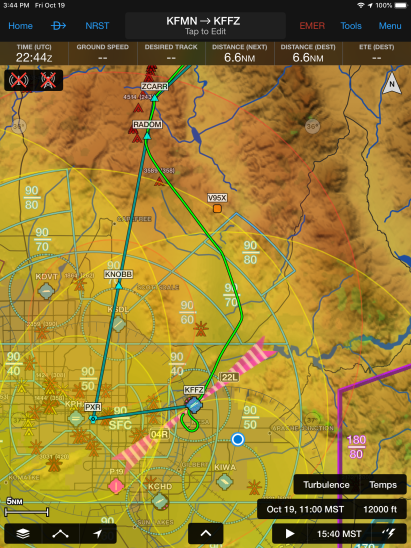
The weather was severe clear and was forecast to remain so. I read the details of the TFR. I called a Leidos flight briefer who patiently worked with me to try to map out each of the rings, where the ring moved with the president at a particular time of day, and related issues. It was like trying to throw darts at balloons blowing in the wind. Ahh, but I had the solution in my back pocket – my IFR ticket.
Pilots on an instrument flight plan are exempted from the Presidential TFR restrictions so long as they remain on their instrument flight plan. The FAA and the Secret Service, and who knows what other government agencies, know who you are, what you are flying, where you are starting, and where you are going. So long as I did not pop up on some terrorist watch list, everything would be easy.
I am glad to report all went well. It was a severe clear day for the trip, I picked up my IFR clearance, departed into the beautiful high desert sky, and followed my routing to Falcon Field in Mesa, AZ. After enjoying time with our son and his family, my wife and I departed by the same means we came – an IFR clearance. The president was going to depart sometime after our scheduled departure, so the TFR was still in effect. No problem. We got our clearance and we were on our way.
An IFR clearance is a great way to go into big city airport space known as “Class Bravo”. VFR traffic is not allowed into Class B airspace without a specific clearance to do so. With an IFR clearance, it is like the Class B designation does not exist. Your IFR clearance is your clearance in and through the Bravo airspace.
I recently used this technique for an 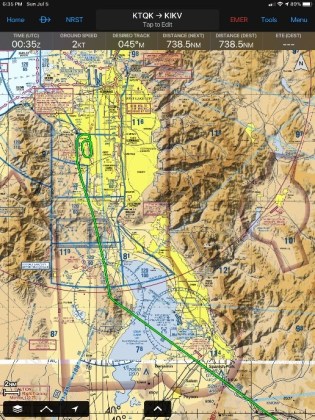 Angel Flight into Salt Lake City. I had not previously flow into the South Valley Airport which is located just a few miles south of the main Salt Lake City airport, is located in the Salt Lake Basin, and has a Restricted Areas immediately to its south. The instrument clearance took me to my destination with no worries about Bravo airspace altitude restrictions ensnaring me, busting into restricted airspace, and put me on the right downwind for my destination airport. I used the same technique for a flight to the McKinney, Texas airport (KTKI) last year.
Just because the sky is overcast does not mean the weather is bad for flying. Stratus layer clouds may be thick but often are very smooth because they are normally present with stable air. A trip that comes to mind is when I was departing Ft Worth Meacham airport (KFTW) to Brazoria County near Houston. I was going down to visit my uncle, Larry Risley, who was in M.D. Anderson for cancer treatment. (Larry and my Aunt Janie were the founders of Mesa Airlines.) The clouds were 800 ft AGL and it was a solid overcast.

We picked up our IFR clearance, took off, and hit the cloud deck at 800 feet AGL and I did not see the ground again until I was about 30 miles outside of Brazoria County Airport (KLBX), where the clouds became scattered. The flight itself was smooth as silk. On our departure a few days later, the same stalled front was present. We took off from Brazoria, hit the clouds about 60 to 70 miles west of there and were solid IMC in smooth conditions almost to San Angelo, Texas. The entire flight was made possible by an instrument rating; otherwise, my wife and I would have been trapped in Ft. Worth waiting for the weather to break. (Photo credit sjkjinks.gov)
RizAir1 frequently takes us on long cross-country flights in excess of 500 nautical miles. On many occasions, a portion of the flight will be IFR due to a weather front, cumulus cloud build-up, or local area conditions. I described such a circumstance in RizAir Blog 15, A Long Day’s Journey To Our Destination: Pre-staging For The Flight Into Oshkosh (https://rizair.blog/2020/02/17/a-longs-day-journey-to-our-destination-pre-staging-for-the-flight-into-oshkosh/), with regard to our leg from Fremont, Nebraska to Stevens Point, Wisconsin. The IFR ticket, once again, makes such circumstances non-events.
I would encourage pilots who do not yet have an instrument rating to get one. It does not matter if you are an old dog or a newly minted private pilot. One of the leading causes of general aviation crashes is VFR pilots flying into instrument meteorological conditions. The result is a loss of control of the aircraft. Your IFR ticket will reduce concerns regarding weather, allow you to confidently launch on long cross-country flights, and it will make you a much better pilot. IFR flying requires precision and the improved ability to control your airplane will make you a better pilot not matter what the meteorological conditions may be. It will also improve your decision making along with your understanding of weather and weather systems.
An instrument rating truly gives you the keys to the kingdom. It opens doors and opportunities you might not otherwise have in flying. It will allow you to increase the utilization of your airplane and to do so more safely. Oh, and one more thing, it greatly increases the fun and adventure of this thing we call private aviation!
Clear Skies and Tailwinds!
Gary Risley
Copyright July, 2020

 RizAir - A Private Aviation Journey
One thought on “GETTING THE KEYS TO THE KINGDOM – The IFR Rating for Private Pilot Aviators”