
Your town needs that the dinky little airport. You know the one I’m talking about, don’t you? The one that is just outside of town hidden in the farm country nearby. Or, the one that is now surrounded by the industrial district in your community. Or maybe it was your town’s original airport before the big new fancy one was built. The one you drive by all the time and ask “Wonder what goes on there?”
There approximately 19,300 airports in the United States. Of those, 18,760 of them are accessible only by private aviation (general aviation) aircraft. They do not have any form of scheduled commercial flight service. Private aviation in the United States directly or indirectly is responsible for more than 1 million jobs and contributes more than $220 billion in economic activity in the country each year. More than 300,000 private general aviation aircraft and 585,000 pilots use those dinky little airports.
Airports are a community resource that can be an economic engine for your community, the last available resource for supplies in the event of a natural disaster, your community’s access to emergency medical services, a reliever for congested airports with scheduled air service, a resource to produce the next generation of pilots, the best way to reach the vacation destination, or a tool to connect your community with the national air transportation system. Or several of the above!
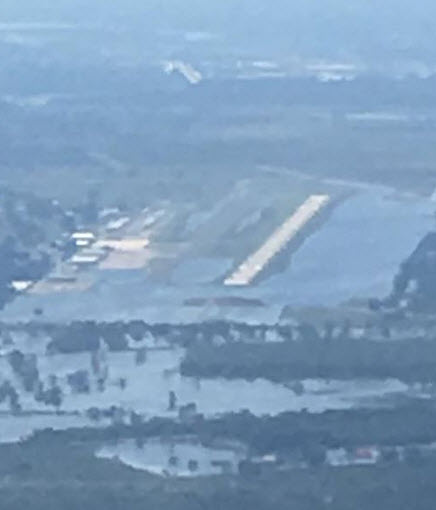
Floods in the Great Plains, particularly Nebraska, in the winter of 2019 proved the value of having that dinky little airport in your town. The Missouri River flooded. The highways were underwater. It was less than 30 miles from a community that was high and dry to a community that was nearly underwater. Freemont, Nebraska, among others, was cut off. Food, water, diapers, and medicine were badly needed. Some people need to be transported out of the community for various medical and personal needs. How could it be done? Thirty miles might as well be 1000 miles if you can’t get there.
Private aviation to the rescue! Following a model I first observed being utilized by Operation Airdrop, the Air Care Alliance network (Angel Flight Central taking lead) called and organized private aviation pilots with the result that greatly needed supplies were delivered and people in need transported. That dinky little airport was Freemont’s only connection to the world. Think of the Berlin Airlift on a smaller scale!

Here is a link to the Facebook video describing the services rendered: https://www.cnn.com/videos/us/2019/03/20/hero-pilots-aid-nebraska-flooding-victims-elam-pkg-Vpx.cnn?fbclid=IwAR0tCWv3Ek6E3pRFBbTnaBb5OB0a4bjwiYZzl74rGQN5J3PPlTwVAgDSXbk. Here is the story posted by one of the volunteer pilots on Reddit: https://www.reddit.com/r/flying/comments/b31z86/helping_flood_victims_the_nebraska_airlift_in_a/. All of this being done without formal government assistance or coordination.
Operation Airdrop ( www.operation-airdrop.com ) is an organization I admire greatly. Born out of Hurricane Harvey when it hit Texas, a group of can-do people organized and coordinated hundreds of pilots flying hundreds, if not thousands, of flights into airports around the Houston and Beaumont areas. Areas were accessible only by air because of the flooding throughout the region. The folks at Operation Airdrop come out of hibernation when their services are needed, get the job done, and then stand aside until needed again. Kind of like the Minutemen of our American Revolutionary period.
Here is a story regarding efforts during Hurricane Florence: https://generalaviationnews.com/2018/10/10/ga-steps-up-in-wake-of-hurricane-florence/?fbclid=IwAR0TzsBqoN5sKIaRZzTJrxCvqdZ-8wGPwMcIHTOMJXGdjJkDMfxzWwzOLpA.
I think this is my favorite video. Landing on the “aircraft carrier” known as the Lake Jackson, Texas Airport following Hurricane Harvey: https://www.facebook.com/eileen.isola/videos/pcb.116701795682390/1425510707532020/?type=3&theater&ifg=1. From the Facebook page: https://www.facebook.com/groups/operationairdrop/.
Emergency and non-emergency medical services are also served by that dinky little airport. I have previously written about Angel Flight non-emergency services. Angel Flight is a nationwide organization, broken into regions, which utilizes private aviation to fly non-emergency medical patients from their generally-remote areas to large urban centers for medical care. It is very rewarding.
The Friday before this blog was written, I flew from my home airport in Farmington, New Mexico to Canyonlands Airport near Moab, Utah where I met another pilot who transported an angel (the patient) and his son from Salt Lake City. The angel had gone to KSLC for stem cell therapy related to leukemia. After a brief period on the ground, I flew them from this remote rural airport to another rural airport in Gallup, New Mexico. These passengers couldn’t get there from here because there is no scheduled air service to Gallup, and it would have been a long drive to gain access to a scheduled carrier. It is an eight hour drive from Gallup to Salt Lake without stops. Travel time by private aviation? Two and a half hours. That is a huge difference when you are sick and don’t feel like going anywhere, or don’t feel like driving an hour and half to be at the airport two hours early so you can take non-direct flights that get you to Salt Lake four or more hours after your first flight took off. You could drive it in less time.
Here’s a photograph recently posted by my friend Ed Notson of the cockpit view as I land at what I jokingly call “Shiprock international Airport.”

The airstrip (5V5) is just outside the small town of Shiprock, New Mexico and is located on the Navajo Reservation. There are no services there, but the airstrip serves an important function by allowing emergency medical aircraft to land so that they might transport critically ill or injured patients from the nearby hospital in Shiprock to larger, better-equipped facilities.
Many doctors fly into and out of reservation airstrips to work part-time at clinics in nearby communities. Without the airstrip, the doctors would not come and important health-care service needs would go unmet. You may not care about that remote strip until one day you are the one who needs, or your family member needs, to get to the trauma center as quick as possible. In that case, that dinky little airport is worth its weight in gold. (Photo courtesy of Ed Notson.)
In larger cities, those dinky little airports serve to relieve congestion at the large hubs were scheduled carrier’s congregate. Can you imagine how crowded an already crowded airline hub would be if all the private aviation aircraft had to go to that airport as well?
The city of Santa Monica, California is making a critical error in planning to shut down its airport. Based on its location, a large number of business aircraft are based at that airport or come to that airport to conduct business in the Los Angeles area. Those individuals then spend money in Santa Monica area and at the airport, and there is a good chance they will locate offices nearby because they have easy access from the airport. A lot of that economic stimulation will disappear when they close the airport and turn it over to real estate developers.
Tourists also fly into Santa Monica Airport because of its convenience to a lot of the attractions nearby. The airport in Van Nuys, California will probably be the greatest beneficiary of Santa Monica’s ill-considered decision.
The Santa Monica airport has served as the base for firefighting operations for aircraft being used to suppress nearby wildfires. When fighting fires, time is critical, and the longer legs to be flown by those aircraft in the future may well lead to greater property losses in the area.
Do you live in an area where the primary economic engine is agriculture? Where do you think the agricultural aircraft operators land and take off? Do some of your local and state law enforcement agencies have aircraft? Where do you think they land and take off? These are just a few more examples of why your town needs that dinky little airport.
The Phoenix area communities understand the value of their little airports. The smaller airports support robust flight training programs, host business aviation facilities, host numerous repair station facilities, and serve to relieve the main airport in Phoenix from the congestion that would result if all the aircraft were based at one or two airports.
The Phoenix-Mesa Gateway Airport, created when an Air Force base closed, has become a crown jewel in the Phoenix area. The economic benefit forecast for the immediate area in 2017 was $1.4 billion, and the airport was forecast to yield $483 million in earnings and support 11,500 jobs. (https://apps.azdot.gov/files/Airports/MP_PDF/PHX_Mesa_Gateway/Gateway_Econ_Benefit_Study.pdf) The other area airports may be smaller, but they have significant positive impact on the local economy as well.
The state of Indiana has noted that there are 119 public use airports in the state and they will generate an economic impact each year in excess of $3.8 billion and employ more than 15,600 people. Most those airports are dinky little airports with no air service, control tower, or fancy terminals. The report notes that the company “GPC” located their grain processing plant in a rural community because there was an accessible, local airport nearby. That dinky little airport resulted in over $300 million being invested by that company in the community. Crown equipment also located in a smaller town because of its dinky little airport which allowed its executives to quickly and easily visit their facilities. (https://docs.lib.purdue.edu/cgi/viewcontent.cgi?article=3698&context=roadschool.)
Those dinky little airports also provide your local community with access to a global market. How do you think that overnight mail service package reaches your desk or business in your small town? Chances are it was flown into that dinky little airport, moved to a truck, sorted, and delivered to you the same day it was received at the airport. Your airport allows businesses to remain in your community that might otherwise have to move to an area with access to an airport in order to be able to ship products and receive supplies related to their national or global business.
It is difficult for a tourist town to make it without a nearby airport. Moab, mentioned before, is a great example. Located near some of the greatest scenery our country has to offer – how do you get there from here? This small airport has some scheduled regional jet service, but it also has a very busy private aviation sector. Skydiving is a popular sport at the airport as I found out when I was trying to squeeze in and out between jumps. Helicopter tours operate from the airport. I am sure supplies and other items needed to support the tourism community come by overnight service every day. I could name many other airports in the Mountain West that provide services just like Canyonlands.
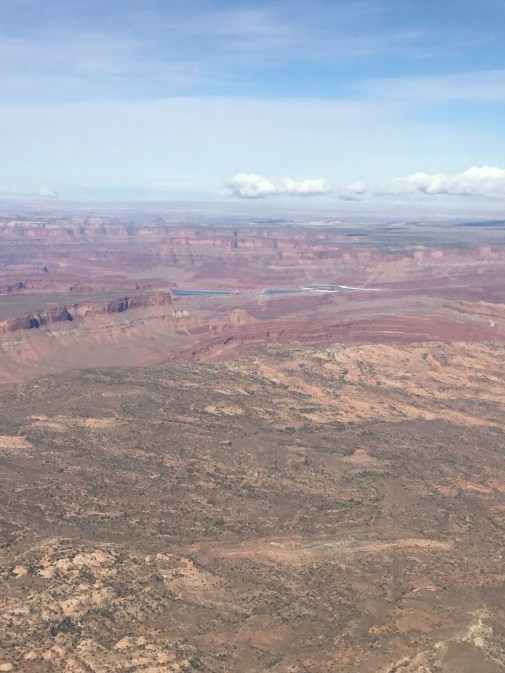
(Photo west of Moab on descent into Canyonlands.)
I could go on and on. Airports are a public service asset, much like highways are, and should be looked at as a tool that is a life raft in an emergency and a cog in the economic engine when it is not serving in an emergency. Just like we rarely see our meal prepared in a restaurant but we know the cook hidden in the back is essential to the business, airports provide benefits to the public that may not be seen or appreciated but are necessary to have a thriving, successful community.
Is your local airport underutilized? Then dream, imagine, explore how it can be utilized to improve and grow the job market in your community. The great thing about aviation is that the assets are mobile. Offer good pricing, local governmental support, job training, whatever, and it is pretty easy for the business to come to you. After all, that is why many of us fly.
So, go ahead, take a drive out to that dinky little airport. Hang around, look around, and talk to the hangar rats sitting around telling lies about their aviation adventures. You might even get a free airplane ride. If you don’t have it already, you may catch the bug to try out this flying thing, and, if not, at least you can understand how important that dinky little airport is to you and your community. See the Airplane Owners and Pilots Association site ( www.aopa.org ) for more information!
Clear Skies and Tailwinds.
Gary Risley
RizAir Blog 11 April 16, 2019

 RizAir - A Private Aviation Journey