If you are already an aviator, this particular blog post may not be for you! If you are interested in aviation in general or interested in learning more about it, here is a primer of the lingo.
Every profession, sport, field of study, etc. has its own language consisting of “made-up” words, acronyms, slang, and other jargon. Many terms we learn from just following a sport for a while; although, I don’t think I will ever figure the terms used in cricket. For example, if one were to say “He is the monster of the gridiron!”, we would know the topic is football because “gridiron” is slang for a football field. “He made the shot from the top of the key” is a reference to basketball where an area of the court which previously, and still is the case in international ball, was an area near the basket that looks like an old fashioned keyhole. “He hit a dinger” is a reference to a homerun in baseball. You get the point.
Aviation has its terms, and this blog is going to be a glorified glossary which introduces you to terms you will need to understand as you read, listen, and watch things about aviation. By the time we are done, you might be able to recognize that a lot of those aviation “experts” on TV really don’t know much of anything because they are not using the correct terms. Many of these definitions and examples will be over-simplied, so you engineers and CFIs out there just chill, okay?
Here we go:
ADS-B – a technology that sends out a radio signal received by stations around the country that shows an airplane’s precise position and altitude based upon a highly precise GPS signal. (ADS-B “out”). ADS-B allows a pilot with the appropriate radios or tablets to see other traffic on their screens and to receive weather information. (ADS-B “In”). Since ADS-B does not rely upon radar sweeps, which can be several seconds in between sweeps, and it provides much more frequent position updates to ATC.
Airline Transport Pilot (ATP) – The PhD of pilot ratings. The pilot must have more than 1500 hours of flying time and pass rigorous written and flying exams. These are the guys flying the heavy iron with the airlines, among other things.
Airspeed – the rate of airflow past the wing. The speed at which the plane is moving through the air. Airspeed and groundspeed only match on a perfectly calm day.
Airmet – Airman’s Meteorological Information. Information of possible hazardous weather of interest to pilots; particularly, pilots of smaller aircraft.
Alerions – the movable part at the end of the wings that cause the wings roll up and down.
Alternate – the airport a pilot plans to fly to if he cannot land at his primary airport due to weather conditions.
Approach – an instrument approach. A published procedure that allows the aircraft to follow a prescribed course so that it may land safely at an airport that is IMC. There are several types of approaches.
Approach Plate – the Diagram and written description of the instrument landing approach procedure to be followed by the aircraft.

ATC – Air Traffic Control – the controllers who direct instrument flight rules traffic and provide VFR traffic advisories known as “Flight Following.” ATC uses radar to track traffic and is moving to a GPS reporting system known as “NextGen”. ADS-B is a GPS reporting system located in airplanes that reports to ATC under the NextGen system.
Attitude Indicator (AI) a/k/a Artificial Horizon – A gauge in the airplane that shows the planes attitude without reference to the visual horizon. Essential to modern IFR flight. It will show if the plane is straight and level, the nose is pitched up or down, and if the wings are down to the right or left side. It is used to make turn under IFR conditions and to set the nose attitude in climbs and descents. 
CAVU – Ceiling and Visibility Unlimited (Think Clear Air – Visibility Unlimited.)
Carb Heat – carburetor heat. Carbureted engines are at risk of a buildup of ice in the carburetor due to fast, but cold, air flow. Carb heat is designed to prevent this ice build-up in the carburetor. Typically used on landing and when in clouds in IMC conditions.
CDI – Course Deviation Indicator – an instrument that one can set to a specific inbound course to a VOR or a specific outbound course from a VOR. While on course the needle will be centered, but if off-course the needle will move left or right indicating in which direction the plane must turn to re-center the needle. 
CFI – Certified Flight Instructor
CG – Center of gravity. Imagine an airplane balanced on the tip of a large nail. Where it comes into perfect balance on the nail is its center of gravity. Airplanes have a forward limit to CG and an aft limit. Operating outside those parameters might make the aircraft unrecoverable in the event of a stall or spin.
Chart – an aviator’s map. Aviation pulled much of its nomenclature from the nautical arena. Both move through a fluid (water or air), both experience currents, and the navigation methods are very similar.
Class A airspace – The airspace from 18,000 feet to 60,000 feet. It is controlled airspace, and one must be on an IFR flight plan to enter Class A airspace.
Class B airspace – B is for Big City. Airspace around big airports. Someone on a VFR flight plan be expressly granted permission to enter Class B airspace and that flight will be under ATC (called “Approach” or “Departure”) control during that time. Class B airspace has horizontal, over the ground, and vertical, altitude, components. There are “speed limits” and other restrictions in Class B.
Class C – the airspace around a “not-so-big” airport, but not small. Mid- level airport. One must make radio contact before entering Class C airspace with ATC. ATC will assign a “squawk” for the plane’s transponder. ATC may or may not provide directional control and traffic separation.
Class D – Towered airports reside in Class D airspace which forms a 5 mile ring around the airport and goes up to 2,500 feet above the airport.
Class E – is controlled airspace where certain rules of flight apply; such as distance from clouds, and visibility when on a VFR flight. It supports both VFR and IFR flights. At lower altitudes, it protects the instrument approach corridors to the airport. It also runs from 14,500 feet to 17,999 feet, and then takes over again at 60,000 feet to infinity and beyond. Speed limit of 250 knots airspeed are in place below 10,000 feet when in Class E.
Class G – the wild, wild West! Airspace uncontrolled by ATC. There are some rules, but they are limited.
Clearance Delivery – at busy airports, an ATC controller who obtains the IFR clearance for a flight, or who obtains general information for a VFR flight to deliver to ATC radar controllers. Often will hand out the squawk when delivering the clearance.
Commercial Pilot – Has received more training than a private pilot and passed extra flight tests. He may be paid to fly people or things around.
Convective Sigmet – really, really significant weather – thunderstorms, the equal opportunity devourer of aircraft.
Currency – not money. A pilot is current when he has met certain recency of flight requirements. For example, a VFR pilot must have 3 take-offs and landings within the previous 90 days in order to carry passengers. An IFR pilot must have flown six instrument approaches (actual or simulated) along with other maneuvers within the preceding 6 months. Pilots who met the specified requirements are “current.”
DA (Density altitude) – the altitude of the air as compared to “standard temperature and pressure” charts. Airplane performance standards are documented as to a “standard” day, which is a specific temperature and barometric pressure at sea level. Airplanes perform better in “thick” colder and /or lower air, and thinner (hotter or higher) air degrades performance. So a hot summer day at a 5000 above sea level airport may have a 9000 foot density altitude. In other words, the airplane “thinks” it is at 9000 feet, not 5000 feet, and it will perform as though it was at 9000 feet in altitude.
DG – directional gyro. A gyroscopic device that displays magnetic compass heading. One refers to the magnetic compass while in straight and level flight or on the ground and sets the indicator to match. A magnetic compass swings during turns, in turbulence, moves during climbs, etc, but the DG does not. Over time the DG will drift off the exact compass heading and is quickly reset to the magnetic compass. A “slaved” DG has a remote compass indicator that keeps it on the actual compass heading.
DH – decision height. The altitude on a precision approach (vertical guidance given) at which the pilot must have the runway environment in sight or go “missed”.
Elevators – the horizontal tail feather of the plane that moves up and down. Moving the elevators will cause the nose to pitch up or down.
Empennage – the tail assembly at the rear of the airplane. Includes the elevators and rudder.
Enroute Charts – IFR flight charts which display the IFR highways in the sky know as “Victor” airways. They do not show physical details about the terrain over which the flight is flown. IFR pilots must carry the chart, in physical or electronic form, for their planned route of flight. 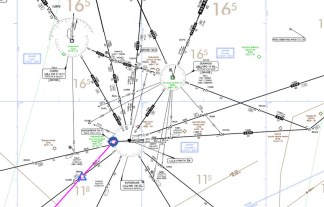
Flaps – a device on the trailing edge of the wing used to increase lift by making the wing “longer”. Pilots refer to “lowering” the flaps because they usually open up and drop down lower than the rest of the wing. With the increased lift comes drag, which slows the airplane down. Most commonly used on landing so that a slower speed while retaining lift may be used to land. Sometime used on shorter field take-offs. 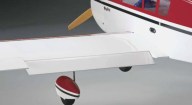
Go-around – aborting a landing and going around for another try.
Groundspeed – the speed of the plane as it flys over the ground. One could have a 120 knot airspeed and a 90 knot groundspeed. This would indicate a 30 knot headwind component.
GPS Approach – An instrument approach utilizing GPS to guide the aircraft. Some GPS approaches mimic an ILS with vertical guidance, some a “localizer” approach (an ILS with no vertical guidance), and some a VOR approach (an approach based upon a radio navigational guidance system).
Ground – ground control at a towered airport. Ground control manges the movements of aircraft (taxi) on the airport up to the end of the runway before take-off and after landing.
HSI– a slaved DG called a horizontal situation indicator. It combines a slaved DG with a CDI into one instrument. More expensive instrument panels have HSIs either in an analog set up or by an electronic indicator that mimics a HSI.
IFR – Instrument Flight Rules. Flights flown under the control of Air Traffic Control (ATC)
ILS – Instrument Landing System approach. The long-time gold standard of approaches. This approach provides both directional guidance along a compass heading that is aligned with the airport runway (called the “localizer”), but also provides vertical guidance down to a specific point on the runway (the “glideslope”). The ILS can take you down to “minimums” (definition below), at which point if the pilot sees the runway he can land.
Instrument Low Altitude Chart – an instrument enroute chart that shows information needed for the navigation of flights below 18,000 feet.
Instrument High Altitude Chart – an instrument enroute chart that shows information needed for the navigation of flights above 18,000 feet.
IMC – Instrument Meteorological Conditions – flying in the clouds.
Intersection – points where two airways meet which is given a 5 letter name.
Jet (turbo-jet) – Suck, squeeze, blow, go – the oversimplified description of how a jet engine works. A jet engine develops “thrust” and that is the unit of measure for its performance. Propeller driven planes measure power in horsepower. If you want to learn much more, here is a link to a BBC program showing a Rolls Royce engine being built: www.youtube.com/watch?v=VfomloUg2Gw.
Jet A – diesel fuel for jets. Diesel, Jet A, and kerosene are cousins. You may have heard of jets referred to as “kerosene burners.”
Minimums – how low can you go? To Minimums! This is the altitude depicted as the lowest altitude one can fly on a particular approach procedure.
MEA – minimum enroute altitude. The lowest altitude a pilot may fly along that “highway” while on an instrument flight plan.
MDA – minimum descent altitude. For non-precision (no vertical guidance) approaches, the lowest altitude to which the plane may descend on the approach until the landing environment comes into view.
Missed (Approach) – if a pilot cannot make the landing following “shooting” the approach (too high, never saw the airport, etc), he will go “missed”. The missed approached is a published procedure telling the pilot what do if he cannot land following an approach.
MOA – Military Operations Area. The Air Force and other military services flight train in these areas. Will not illegal, it can be dangerous to cross a MOA when it is “hot” – military flight activity is taking place.
Piston – a airplane with a piston engine as compared to a turbine (jet) engine. Most cars are piston engines powered, but most airplane engines are air-cooled, not liquid cooled the way cars are. Piston engine airplanes will have a propeller, but not all aircraft with a propeller are piston engine powered.
Private Pilot: A pilot with his license who may not fly other people or things for hire. Think cab driver or commercial truck driver as compared to ordinary citizen driver.
Rabbit – a series of bright lights that appear to “run” towards the end of a runway. It is a great visual aid when shooting a low visibility, low ceiling instrument approach. Sometimes the lights are too bright, and the pilot will ask the tower to “kill the rabbit.” Here is a link to a YouTube video of a rabbit in action: https://www.youtube.com/watch?v=u59bJZEitRI.
RNAV – Area Navigation. A system of navigation by which a pilot can skip flying over VORs and fly directly to a particular point. Earlier RNAV was a form of flight computer that would allow one to “move” electronically a VOR a certain distance so the pilot could fly a straighter path. Today, GPS navigation systems, if certified for IFR flight in an instrument flight rule situation, serve the RNAV function.
Restricted Area – Flights into the area are prohibited most of the time. Cannot go there unless the area is “cold” and ATC approves.
Reserves – the amount of fuel needed to meet the FARS (or higher personal minimums) upon arrival at the destination airport.
Rudder – the part of the fin at the back of an airplane that moves back and forth which causes the nose to move side to side.
Sectional Chart – an aeronautical chart showing items of interest to a pilot an aircraft. It is not a tourist map. It is used to plan and follow navigation plans, mostly by VFR pilots. VFR Pilots are required to have the appropriate VFR charts for the areas in they fly on board the aircraft in paper or electronic form.
Seized/ Failure – aircraft engines when they stop working seize or fail, they do not stall. You will hear “The engine seized” or “The engine failed” from aviators, not “The engine stalled.”
Sigmet – Significant Meteorological Information. Weather bad enough to affect the safety of flight of all aircraft, even the big boys!
Stall – the point at which a wing cannot generate lift. Certified aircraft at a stall will drop their nose to regain airspeed and “break” the stall. Stalls have nothing to do with aircraft engines. They are learned and practiced by pilots as part of training and are not a threat unless they occur at a very low altitude.
Squawk – an assigned code to be entered into an airplanes radio transponder which emits a specific four-digit number back to ATC when “hit” with a radar signal. It helps ATC track aircraft by tail number in managing the system. The pictured transponder is “squawking VFR”, the code for traffic that is operating VFR without flight following.
T-Routes: Approved RNAV routes depicted on the enroute charts
Tower – the operator that provides the take-off and landing clearances at a towered airport.
Turbo-charged: A piston engine airplane which has a turbo-charger on its engine to boost airflow to the engine. It, in effect, creates more dense air feeding the engine by “compressing” it, which allows the engine to produce more power at higher altitudes. The folks at Bold Method have an excellent article with pictures showing how a turbo-charger works: http://www.boldmethod.com/learn-to-fly/aircraft-systems/how-a-turbocharger-system-works/.
Turbo-prop is a small jet engine with a propeller attached. It is a turbine engine and burns Jet-A just like its big brothers. Here is a video of how the Pratt and Whitney PT-6, probably the most popular turbo-prop engine the world, works: http://www.youtube.com/watch?v=_dKkl9fDcZY..
Type rating – A rating to fly a specific aircraft which is either a jet or which weighs more than 12,500 lbs. The pilot has demonstrated proficiency in flying that aircraft to a designated examiner.
Waypoint – a designated spot on a chart, usually an IFR enroute chart or approach plate, that is similar to an intersection, but which may not be attached to an airway. A benchmark while enroute to a destination.
Weight and Balance – a calculation to determine that an airplane, with passengers, fuel, and baggage is below its gross maximum weight, and to determine that the balance of the aircraft (its CG) is within limits.
VOR – Very High Frequency, Omni-directional Range. A radio navigation aid that can guide a plane to (towards) the VOR and from (heading away from) the VOR. Navigation is done by turning the CDI to the desired “radial” (heading) and “centering” the indicator needle. By keeping the “needle” of the CDI centered, one is flying a defined compass direction either to or from the station. If one is flying the 180 degree radial from the VOR, he is flying a magnetic course of 180 degrees from the VOR, and the CDI needle, when centered, is showing the pilot he is on the correct course/radial.
Victor Airway – an instrument highway in the sky which goes from VOR to VOR. The V is for VOR highway, compared to the old L/MF (low/medium frequency) airways based upon old radio beacons. There are also “J Airways” which are high altitude jet airways.
VFR – Visual Flight Rules. Clouds 1000 feet above the ground and 3 miles visibility; although, most of us would consider that marginal VFR.
V speeds – various speeds that provide limits on the aircraft. There is a v speed for stalling, there is a v speed for lowering flaps, there is a v speed for lowering the landing gear, a v speed for normal cruise, and a v speed for “never exceed”, etc. The have various short-hand symbols too numerous to discuss here.
Yoke – the control wheel, or better: where the control wheel is mounted.
100LL – 100 octane low lead fuel. The common fuel now available to piston powered aircraft.
There you have it! Of course, there are far more terms, but if you read or hear pilot lingo you don’t understand, there is a good chance that it will be on this list. If I use a word in a blog you don’t understand, run back here and read its meaning.
Now, we will move forward with more fun stuff in the near future!
Clear skies and tailwinds!
Gary Risley

 RizAir - A Private Aviation Journey
One thought on “IF YOU’RE GOING TO HANG WITH THE NATIVES YA GOTTA LEARN THE LINGO! (A/K/A AVIATION ALPHABET SOUP)”